Key Skills
Bioengineering demands technical expertise, industry awareness, and problem-solving ability. MIT-ADTU BIO sets students with a skill mix attuned to the biotechnology, bioinformatics, biomedical, and IT sectors.
Biotechnology
Biotechnology
- Aseptic techniques for microbial handling
- Biochemical characterisation of bacteria
- Bacterial identification through 16s RNA sequencing
- Cell culture techniques
Bioinformatics
Bioinformatics
- Programming in Python, Perl, and Java
- Statistical modelling with R and MATLAB
- Data analytics and predictive modelling
- High-throughput data processing
Biomedical
Biomedical
- Tissue engineering principles
- Medical device design and validation
- Hospital-based practical training
- Safe handling of medical equipment
Information Technology
- Software development in C, C++, Java, Python, R, and HTML
- Database management with MySQL and SQL Server
- Exposure to Hadoop, Raspberry Pi, Arduino, Docker, and TensorFlow
- SDLC implementation in industry projects
Soft Skills
Soft Skills
- Effective communication
- Time and resource management
- Critical thinking and adaptability
- Team collaboration
Hackathons, workshops, and industry-led sessions refine these skills, priming students for the demands of research and corporate environments.
Internships
Industry experience sets graduates apart. From the third year, students complete summer internships, while BTech and integrated MTech students undertake a six-month final-year project. These placements provide first-hand exposure to research, biotech firms, and hospital environments.
Training in resume development, interview techniques, and industry expectations ensures a smooth transition from academia to employment. Guidance from industry professionals sharpens students’ approach and helps them secure the right roles.
Higher Studies
For students pursuing advanced education, MIT-ADTU BIO offers pathways to MTech, MS, and PhD programmes in bioengineering and biomedical sciences. With bioengineering gaining global traction, postgraduate and doctoral qualifications unlock opportunities in research, academia, and industry specialisations.
Collaborations with universities in Ireland, Singapore, and the USA offer access to international research initiatives. Faculty-led counselling sessions help students navigate applications and prepare for GRE, TOEFL, and IELTS.
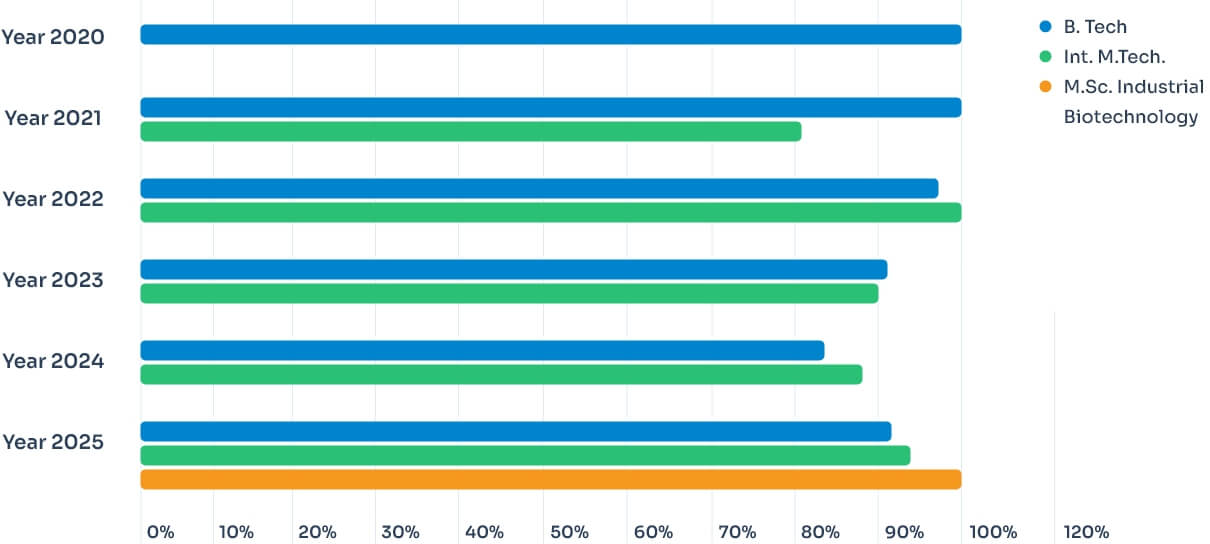
Placement Summary Statistics
-
Year 2020
- B. Tech – 100%
Year 2021
- B. Tech – 100%
- Int. M.Tech. – 82.35%
Year 2022
- B. Tech – 97.05%
- Int. M.Tech. – 100%
Year 2023
- B. Tech – 91.89%
- Int. M.Tech. + M.Tech Environmental Bioengineering – 90%

- Vasantdada Sugar Institute,Manjari,Pune
- ICAR-NRCG,Manjari,Pune
- National Center For Microbial Research(NCMR), Pune
- National Centre for Cell Science, Pune
- CSIR- NCL, Pune
- Haffkine, Pune
- DIAT(Defence Institute of Advanced Technology), Pune
- IBAB, Bengaluru
- DEBEL(Defence Bioengineering Electro-Medical Laboratory), Bengaluru
- IIT Delhi
- IIT Madras
- BARC, Mumbai
- National Center For Biological Sciences, Bengaluru
- Haffkine Biopharmaceutical corporation limited, Mumbai
- IIT, Mumbai
- Agharkar Research Institute, Pune
- Tata Institute at Genetics and Society, Bangalore
- CSIR- Central Drug Research Institute, Lucknow
- NIT Warangal
- School of Health Systems Studies,Tata Institute of Social Sciences, Mumbai
- ACTREC, Navi Mumbai
- Bioinformatics Centre, Savitribai Phule Pune University
- Tata institute of social sciences
- DBT- InStem
- Institute of Life Science -DBT (Bhubaneswar)
- NCL VENTURE CENTER, PUNE